
Anthropic Releases Claude Opus 5.5: Over 30% Faster and 40% Cheaper to Run
Claude Opus 5.5 is the first model in the Claude 5.5 family. Token prices drop 20%, cache reads drop 60%, output is over 30% faster, and it uses fewer tokens per task, netting a 40% drop in real costs versus Opus 5.
By Nattapon YongpaiboonCo-founder, Claude Thailand Community
Anthropic has released Claude Opus 5.5, faster and cheaper
Opus 5.5 is the first model in the Claude 5.5 family. Anthropic says it performs at the level of Claude Fable 5.1 on most work while costing 40% less to run than Opus 5.
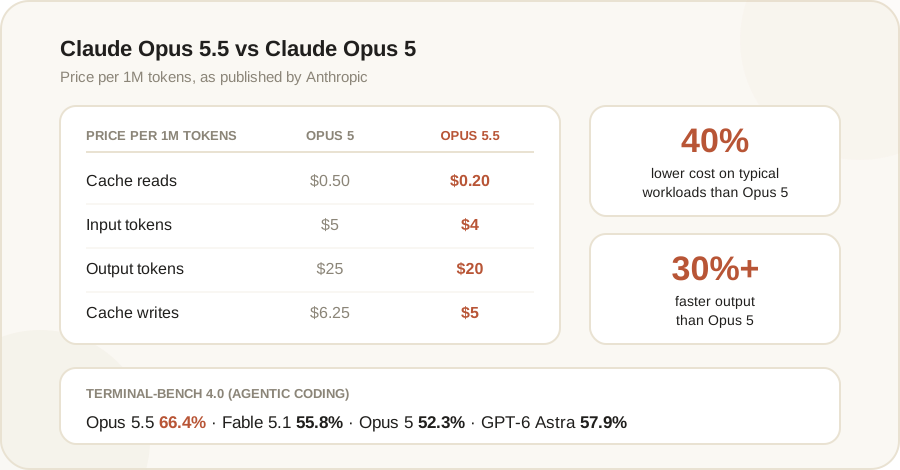
The per-token price itself only drops 20% (input from $5 to $4, output from $25 to $20 per million tokens). The rest of the 40% saving in real use comes from Opus 5.5 using fewer tokens for the same task, combined with generating output more than 30% faster. Put together, actual costs fall by close to half.
What changed
- Cache reads are cheaper, from $0.50 to $0.20 per million tokens, a 60% cut. These make up the majority of costs for agents running long jobs. Cache writes drop from $6.25 to $5.
- Overall capability is close to Fable 5.1 on most work, but agentic coding benchmarks are clearly ahead of Opus 5. On Terminal-Bench 4.0 it scores 66.4% against Opus 5’s 52.3%.
- Some striking real test cases, such as one tester completing a 680,000-line code migration in less than a day, work that would normally take weeks.
- Higher five-hour usage limits on Pro, Max, Team, and seat-based Enterprise plans, plus a rate limit reset that subscription users can save and use whenever they choose.
Numbers from Anthropic’s own testing
Beyond the 680,000-line case, the announcement gives several other examples.
- One tester audited and fixed a 200,000-line codebase in under three hours, where Opus 5 took over 20 hours and used 2.5 times as many tokens.
- In an internal test translating HAProxy from C into Rust, Opus 5.5 finished in 9.5 hours against 12 for Fable 5.1, and cost 51% less.
- Asked to cut load times across every page of a web app, Opus 5.5 succeeded 39 times out of 40.
- On a merger analysis task, Opus 5.5 finished in 63 minutes against 93 for Opus 5, at half the cost.
On knowledge work, Opus 5.5 scores 1846 Elo on GDPval-AA v2.1, which tests real-world work across 44 occupations, ahead of Fable 5.1 at 1735 and Opus 5 at 1708.
Anthropic itself notes that at these capability levels, benchmark margins have become a less reliable guide to real-world differences, and that in its own use the gap between Opus 5.5 and Fable 5.1 is narrower than the scores suggest.
Better writing and communication
Anthropic highlights communication as a major improvement, since it was one of the most common pieces of feedback about Opus 5. The new version puts the most important information up front, uses less jargon, and follows the writing rules you give it more closely. Early testers said it was clearer and easier to follow, especially during long working sessions.
Safety
Anthropic says Opus 5.5 is the strongest-performing model it has tested on its automated behavioral audit, an alignment suite covering nearly 2,000 scenarios. It is much less likely to take hard-to-reverse actions or act outside the boundaries it has been given. On a new evaluation of how often a model tries to cross containment boundaries, Opus 5.5 attempted this around 85% less often than Opus 5, and it resists prompt injection better than before.
It was tested before release by outside evaluators including METR and Frontier Design. Because Opus 5.5 is highly capable in biology and cybersecurity, it ships with safeguards similar to Fable 5.1’s: most cybersecurity tasks are re-routed to Opus 4.8, while organizations doing serious biology research can apply to the Life Sciences Verification Program.
Where you can use it
Opus 5.5 is available on all platforms, including Amazon Web Services, Google Cloud, and Microsoft Azure. Developers on the Claude Platform can get started with the model name claude-opus-5-5. A Fast mode with up to 2.5x speed is also available in Claude Code and the Claude Platform, at $8 per million input tokens and $40 per million output tokens.
Anthropic says Claude Sonnet 5.5 and Claude Haiku 5.5 will follow in the coming weeks with many of the same improvements.
Editor’s take
The most interesting part of this release isn’t the benchmark scores, it’s the cost. The 60% cut to cache reads matters more than it might look for anyone running long agent sessions, because the big expense in that kind of work is re-reading existing context, not generating new text. For everyday users, the clearer writing and the higher usage limits are the parts that land.
Have you tried Opus 5.5 yet? Does it actually feel faster?
The information in this article is based on Anthropic’s official announcement at anthropic.com. Read the original source in the link below.
Get it by email
New articles, Claude updates and community event announcements. Sent occasionally, never often enough to annoy you.
The newsletter is written in Thai